

Echocardiogram: Types & What To Expect
An echocardiogram is a non-invasive ultrasound test that provides detailed images of the heart’s structure and function. There are different echocardiogram types, including the Transthoracic Echocardiogram (TTE), Transesophageal Echocardiogram (TEE), and Doppler Echocardiogram, each used for specific diagnostic purposes. During the procedure, a transducer is placed on the chest or, in the case of TEE, inserted into the esophagus to capture clear images. At Cardiovascular Medical Associates, Board-certified Dr. Kaushal Tamboli and our team ensure a comfortable experience while providing accurate heart health assessments. For more information, contact us or book an appointment online. We are conveniently located at 8317 Davis St, Downey, CA 90241.
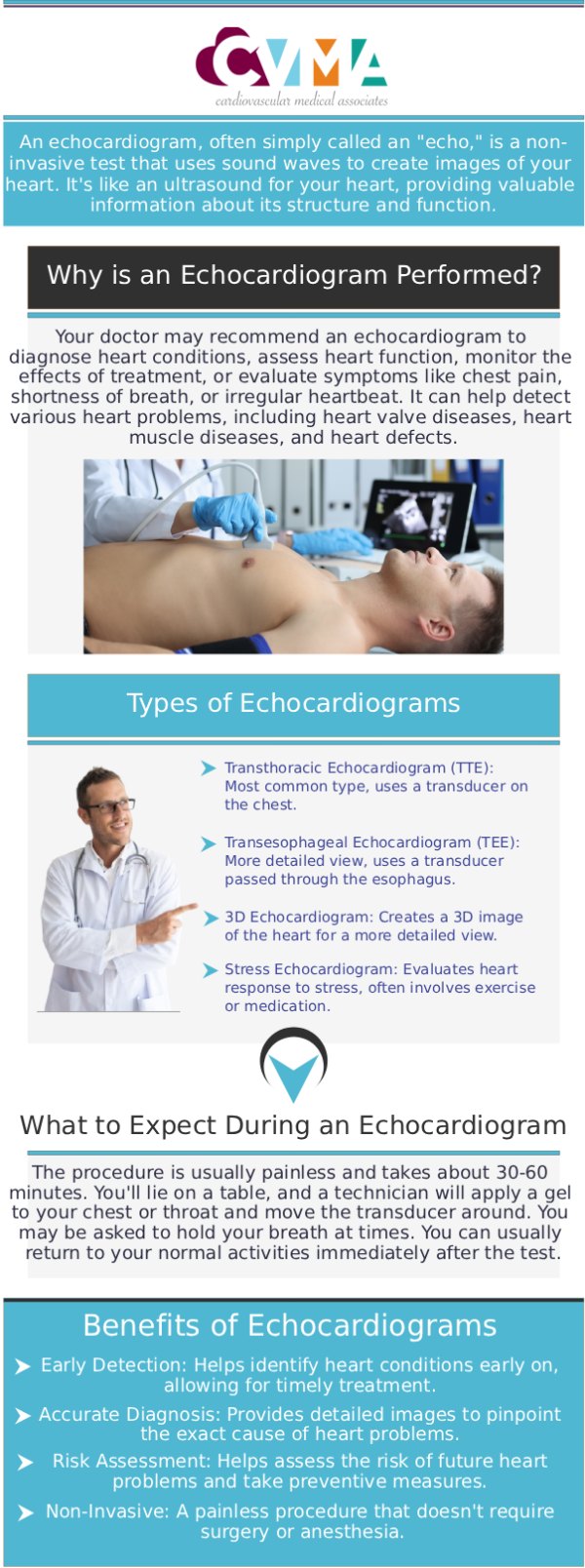
Table of Contents:
What are the different types of echocardiograms?
What are the benefits of echocardiograms?
What happens after my echocardiogram?
What conditions are diagnosed with an echocardiogram?
What happens during an echocardiogram?
How long does an echocardiogram usually take?
Echocardiograms: What to Expect with Board-Certified Dr. Kaushal Tamboli and Our Team at Cardiovascular Medical Associates, Downey, CA
Echocardiograms are essential diagnostic tools used to assess heart health, and there are different types to capture specific details about the heart’s structure and function. The most common type is the Transthoracic Echocardiogram (TTE), where a transducer is placed on the chest to send and receive ultrasound waves. This provides a detailed view of the heart’s chambers, valves, and blood flow. TTE is non-invasive and typically used for routine check-ups or to monitor existing heart conditions.
Another important type is the Transesophageal Echocardiogram (TEE), which is used when clearer, more detailed images are needed. This procedure involves inserting a probe into the esophagus, closer to the heart, allowing for a more comprehensive assessment, particularly for issues with heart valves and blood clots. Additionally, Doppler Echocardiograms are used to evaluate blood flow, while Stress Echocardiograms assess how the heart functions under physical stress, such as during exercise or with medication. Each type of echocardiogram is tailored to the patient’s specific needs, ensuring an accurate diagnosis and effective treatment plan.
Echocardiograms, also known as ultrasounds of the heart, offer numerous benefits for diagnosing and managing cardiovascular conditions. At Cardiovascular Medical Associates, Dr. Kaushal Tamboli and our team utilize this non-invasive procedure to provide essential insights into your heart’s health.
One of the key benefits of an echocardiogram is its ability to evaluate heart function, structure, and blood flow. This allows Dr. Tamboli and our team to identify conditions like heart valve problems, congenital heart defects, and other structural issues that may not be visible through other testing methods. It’s an essential tool for diagnosing heart conditions in their early stages, even before symptoms appear, providing a proactive approach to heart health.
Echocardiograms are also instrumental in monitoring the effectiveness of ongoing treatments for heart conditions. Whether you’re undergoing treatment for heart disease or recovering from a heart attack, this test can track progress and help adjust treatments accordingly. Furthermore, it offers a safe and accurate alternative to more invasive diagnostic techniques.
In addition, echocardiograms are valuable for monitoring blood clots or assessing the heart’s pumping efficiency, making them crucial in the management of conditions like heart failure and atrial fibrillation. By offering a comprehensive view of the heart’s health, echocardiograms contribute significantly to the early detection and prevention of severe heart conditions.
After your echocardiogram, the next steps are dependent on your individual condition and the results obtained. Typically, you will be free to resume your regular activities immediately following the procedure, as there are no side effects or recovery times associated with this non-invasive test.
Once the echocardiogram is complete, the images will be reviewed by Dr. Tamboli, who will analyze the findings in detail. If the test reveals any areas of concern, Dr. Tamboli may discuss further diagnostic tests or treatment plans with you to address any potential issues. This could include additional imaging or referrals to specialists if needed.
For many patients, the results of an echocardiogram help provide peace of mind, as the test is highly effective at detecting issues early on. If you’re being monitored for a heart condition, you may be asked to schedule follow-up appointments to track progress.
Whether you’re undergoing the test as part of a routine check-up or for a specific condition, our team at Cardiovascular Medical Associates ensures that you receive the necessary information and support based on your results.
An echocardiogram is a crucial diagnostic tool for detecting a variety of heart conditions, and at Cardiovascular Medical Associates, Dr. Kaushal Tamboli and our team use it to identify and monitor several heart-related issues.
Conditions commonly diagnosed with an echocardiogram include heart valve problems, such as valve stenosis (narrowing of the valve) and valve regurgitation (leaking of the valve). These conditions can lead to ineffective blood flow and are often undetected until later stages, making echocardiograms vital for early detection.
Echocardiograms are also effective in diagnosing heart failure, congenital heart defects, and the enlargement of the heart. By assessing the heart’s size and shape, we can determine if it is working at full capacity and whether any abnormal growth or movement is present.
In addition, an echocardiogram is used to diagnose blood clots, pericardial disease, and certain types of arrhythmias (irregular heartbeats). These conditions, when identified early, can significantly improve a patient’s quality of life by allowing for targeted treatments to prevent complications.
By offering a real-time image of your heart’s activity, an echocardiogram is essential for maintaining a healthy heart and diagnosing conditions before they progress.
During an echocardiogram, you will be asked to lie down comfortably on an examination table. A gel will be applied to your chest to help the ultrasound waves transmit more effectively, and a small device called a transducer will be moved over your chest.
The transducer sends high-frequency sound waves to your heart, which then bounce back to create real-time images of your heart’s structure and blood flow. This procedure typically takes around 30 minutes and is completely painless. The images are then analyzed by Dr. Tamboli and our team to detect any abnormalities in heart function.
While you lie still, the technician or doctor may ask you to briefly hold your breath or change positions to get the clearest images possible. In some cases, a special form of echocardiogram, called a Doppler ultrasound, may be used to evaluate blood flow or pressure within the heart.
It’s a straightforward, non-invasive procedure that helps Dr. Tamboli gain a comprehensive understanding of your heart’s health, providing key insights into your overall cardiovascular well-being.
An echocardiogram typically takes between 30 and 60 minutes. The length of the procedure depends on factors such as the complexity of the test and the specific areas of the heart being examined. Dr. Kaushal Tamboli and our team prioritize your comfort and make every effort to conduct the test as quickly and efficiently as possible.
The process begins with applying a gel to your chest, which helps the transducer capture high-quality images of your heart. The technician will then guide the transducer over your chest to capture various views of the heart and its structures. If additional views or special techniques are needed, it may take a bit longer.
While the echocardiogram itself doesn’t take long, the time needed for Dr. Tamboli to analyze the images and discuss results may vary. Depending on the findings, Dr. Tamboli may recommend follow-up tests or treatments.
Echocardiograms are designed to be as efficient as possible while ensuring comprehensive results, helping Dr. Tamboli monitor heart health accurately.
At Cardiovascular Medical Associates, Dr. Kaushal Tamboli and our experienced team provide comprehensive echocardiogram services to help diagnose and monitor a wide range of cardiovascular conditions. An echocardiogram is a non-invasive ultrasound that provides detailed images of your heart’s structure, function, and blood flow.
Dr. Tamboli and our team will explain the process, review your symptoms, and determine the most appropriate type of echocardiogram for your needs. Whether you’re undergoing this test as part of a routine check-up or to evaluate a specific condition, we ensure that you are comfortable throughout the procedure.
After the test, our team will carefully review the results with you and discuss any necessary next steps. We ensure you fully understand your heart health and the treatment options available, offering personalized care to address your needs. For more information, contact us or book an appointment online. We are conveniently located at 8317 Davis St, Downey, CA 90241. We serve patients from Downey CA, Norwalk CA, Lynwood CA, Cerritos CA, Lakewood CA, Whittier CA, and surrounding areas.
Check Out Our 5 Star Reviews





 Send Text
 How May I Help You?