

How Does a Transesophageal Echocardiography (TEE) Test Work?
Transesophageal echocardiography (TEE) is a specialized imaging technique that provides detailed pictures of the heart and its structures, helping diagnose a variety of heart conditions. Dr. Kaushal Tamboli, MD, at Cardiovascular Medical Associates, utilizes TEE to gain a clear and precise view of the heart’s function and detect abnormalities such as valve issues or blood clots. For more information, contact us or book an appointment online. We are conveniently located at 8317 Davis St, Downey, CA 90241.
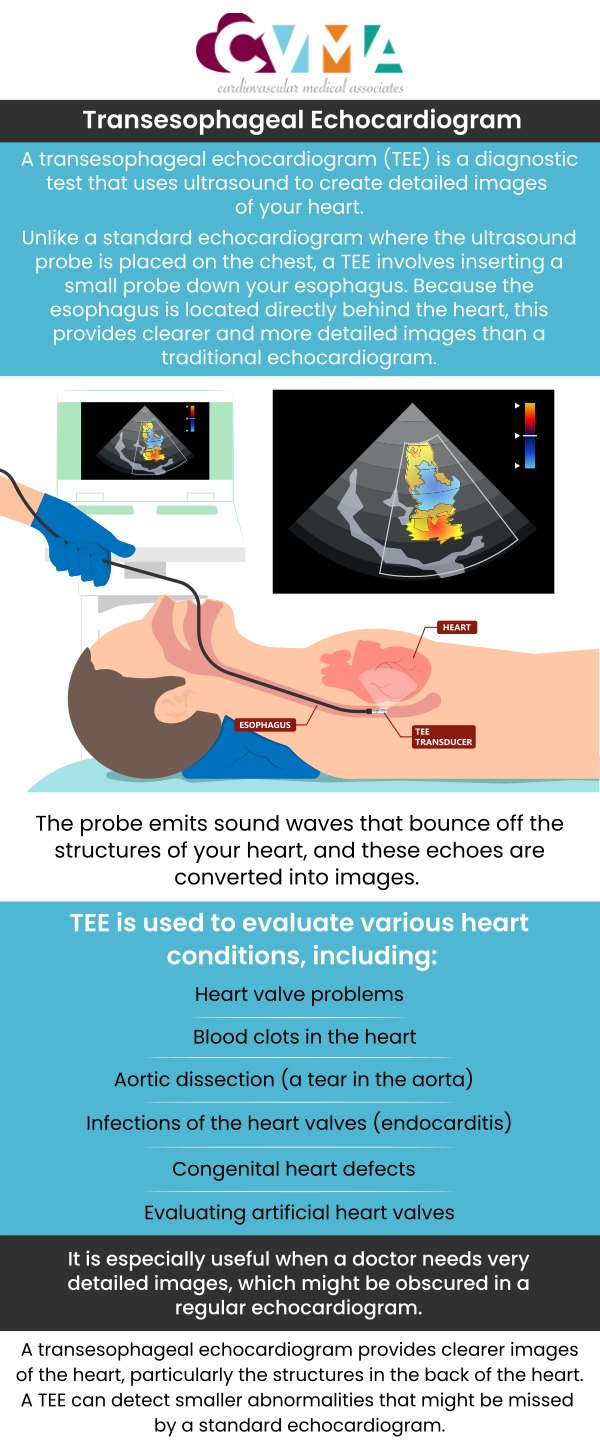
Table of Contents:
What can a transesophageal echocardiography detect?
How is a transesophageal echocardiogram done by Kaushal Tamboli, MD?
What is the success rate of a transesophageal echocardiogram?
How long does a transesophageal echocardiogram take?
How can Dr. Kaushal Tamboli use a transesophageal echocardiography (TEE) test to evaluate your heart health?
At Cardiovascular Medical Associates, we are committed to providing our patients with the most advanced diagnostic tools available for comprehensive heart care. One of the specialized procedures we offer is transesophageal echocardiography, or TEE. This advanced ultrasound technique uses a thin, flexible probe gently guided down the esophagus, allowing our expert cardiologists to capture highly detailed images of your heart’s structure and function.
Because the esophagus is located directly behind the heart, TEE enables our team to detect cardiac conditions with far greater clarity than a standard echocardiogram performed on the chest wall. This precision is crucial for identifying issues such as blood clots, cardiac masses, or tumors within the heart chambers. TEE is especially effective in diagnosing infections of the heart valves (endocarditis) and assessing valve abnormalities, including stenosis (narrowing) or regurgitation (leakage).
Our physicians often use TEE to evaluate congenital heart defects—structural issues present from birth—such as atrial or ventricular septal defects. For patients who have experienced a stroke or are at risk, TEE is invaluable in pinpointing potential sources, like clots or plaques that may have migrated from the heart to the brain. In individuals with atrial fibrillation, our team utilizes TEE to ensure there are no clots in the left atrial appendage before performing procedures to restore a normal heart rhythm. Additionally, TEE is an essential tool for monitoring the function of artificial heart valves and guiding our specialists during complex cardiac surgeries or minimally invasive interventions.
A transesophageal echocardiogram, or TEE, is a procedure that uses ultrasound technology to visualize the heart from inside the esophagus, which lies just behind the heart. This vantage point allows for clearer and more precise imaging than standard external echocardiograms.
Under the care of our experienced physicians, such as Dr. Kaushal Tamboli, MD, patients are first asked to fast for several hours before their TEE to ensure safety during the examination. Upon arrival at our practice, patients are positioned comfortably—usually on their left side. To minimize discomfort, a local anesthetic is applied to numb the throat, and a mild sedative is administered through an IV to help the patient relax.
Once prepared, a thin, flexible tube with a tiny ultrasound probe at its tip is gently inserted through the mouth and guided into the esophagus. Because the esophagus is located directly behind the heart, this approach avoids interference from the ribs and lungs, resulting in extremely clear images.
During the test, Dr. Kaushal carefully maneuvered the probe to assess different parts of the heart, including the chambers, valves, and nearby blood vessels. The high-quality images produced allow us to:
●Evaluate heart function and structure
●Detect blood clots, valve disease, or infections
●Diagnose congenital heart defects or other abnormalities
The entire procedure usually takes between 30 and 60 minutes. After the TEE, the probe is gently removed, and patients are monitored as the sedative wears off. Most individuals can return home the same day, with specific instructions to wait until throat numbness resolves before eating or drinking.
Our team is highly experienced in performing TEE, and the success rate of this procedure in our practice reflects national standards, with more than 95 to 99 percent of studies resulting in high-quality, diagnostic images. TEE is both safe and effective, allowing our cardiologists to make well-informed decisions about your care.
While TEE is generally very well tolerated, there are rare cases where the procedure cannot be completed due to patient discomfort, difficulty swallowing the probe, or certain esophageal conditions. However, such instances are uncommon, and our staff takes every precaution to ensure your safety and comfort throughout the process. At Cardiovascular Medical Associates, we are committed to using reliable and advanced diagnostic techniques like TEE to guide your cardiovascular care and achieve the best possible outcomes for our patients.
At Cardiovascular Medical Associates, we offer transesophageal echocardiograms (TEE) as part of our comprehensive heart care services. A TEE is a specialized ultrasound test that provides detailed images of your heart by using a small probe inserted into the esophagus. This allows our cardiologists to closely examine the heart’s structure and function, helping us accurately diagnose and manage various cardiovascular conditions.
The TEE procedure at Cardiovascular Medical Associates typically takes about 30 to 60 minutes to complete. This includes preparation, the procedure itself, and a short recovery period. The imaging portion, during which the ultrasound probe is gently guided into your esophagus to visualize your heart, usually lasts 10 to 20 minutes. Before we begin, our experienced medical team will review the process with you, answer any questions, obtain your consent, and administer sedation to ensure your comfort.
After your TEE, you will relax in our recovery area for about 30 minutes to an hour while the sedative wears off. Our staff will monitor you closely and provide post-procedure instructions to ensure a safe and comfortable experience. In total, you should expect your TEE appointment at Cardiovascular Medical Associates to take approximately one to two hours from start to finish.
Dr. Kaushal Tamboli, MD, at Cardiovascular Medical Associates in Downey, CA uses transesophageal echocardiography (TEE) to obtain detailed images of the heart. Unlike traditional echocardiograms, a TEE involves inserting a specialized probe down the esophagus to get a closer view of the heart’s structure and function. This test is particularly helpful in diagnosing conditions like heart valve problems, blood clots, or infections in the heart. Dr. Tamboli may recommend a TEE if standard tests do not provide clear enough results.
The procedure is generally safe and minimally invasive, offering more accurate images of the heart. With the detailed information from the TEE, Dr. Tamboli can tailor a treatment plan to address any underlying heart conditions, helping you maintain optimal heart health and reduce the risk of complications. For more information, contact us or book an appointment online. We are conveniently located at 8317 Davis St, Downey, CA 90241. We serve patients from Downey CA, Norwalk CA, Lynwood CA, Cerritos CA, Lakewood CA, Whittier CA, and surrounding areas.
Check Out Our 5 Star Reviews





 Send Text
 How May I Help You?